Paris, 1255. In a hall at the University of Paris, a twenty-year-old student rises to defend his thesis. He's been preparing for months, but preparation won't save him if his arguments don't hold. Facing him sit his masters and fellow students, ready to attack every claim, probe every weakness, expose every gap in his reasoning. This is the disputatio—the formal debate that stands between him and his degree. For the next several hours, he must defend his ideas against all challengers. If he survives, he's proven he can think. If he fails, he goes back to study more.
This student might have been Thomas Aquinas, who endured disputations before becoming one of history's greatest systematic thinkers. Or Duns Scotus, whose reputation for subtle argument made his name synonymous with precision. For over five centuries, from Bologna to Oxford to Salamanca, no one earned a degree without surviving this trial. Knowledge that couldn't withstand scrutiny wasn't knowledge at all.
Then we abandoned it. Modern education replaced debate with lectures, textbooks, and standardized tests. We teach students mathematics they'll rarely use. We teach them dates they'll forget. We teach them to bubble in correct answers. But we don't teach them to construct arguments, defend positions, or change minds through reason—the skill that will determine whether they're heard in every meeting, interview, and crucial conversation of their adult lives. The results surround us: graduates who can recite facts but can't construct arguments, who know what to think but not how to think.
WHAT SCHOOLS FORGOT
The "three roads" of classical education: grammar (understanding language), logic (reasoning correctly), and rhetoric (persuading effectively). These weren't separate subjects but stages of development—you learned to understand, then to analyze, then to communicate. The trivium preceded the quadrivium (arithmetic, geometry, music, astronomy) and was considered essential preparation for all advanced study.
The classical curriculum—the education that shaped minds from ancient Greece through the Renaissance—stood on three pillars: grammar, logic, and rhetoric. Grammar taught you to understand language. Logic taught you to reason. Rhetoric taught you to persuade. Together, they formed the trivium, the foundation of all further learning. You couldn't study law, medicine, or theology until you'd mastered the arts of thinking and arguing.
Something changed in the nineteenth and twentieth centuries. Schools began emphasizing content over method, information over argumentation. Science replaced philosophy as the model discipline. The goal became knowing things rather than thinking about things. Rhetoric, once the crown of the curriculum, became an afterthought—if it appeared at all.
Education is not the filling of a pail, but the lighting of a fire.William Butler Yeats — attributed
The consequences are visible everywhere. Students graduate unable to make sustained arguments in writing. They struggle to evaluate the arguments others make to them. They accept claims at face value or reject them reflexively, lacking the tools to assess evidence and reasoning. When they encounter disagreement, they don't know how to engage productively—they either avoid conflict entirely or escalate it into combat.
The irony is that we now have more information available than any generation in history—and less ability to evaluate it. A student can Google any fact in seconds but can't determine whether what they're reading is true. They can access millions of opinions but can't distinguish good arguments from bad ones. The skills that the trivium provided—and that modern education abandoned—are precisely the skills that the information age demands.
DEBATE AS PEDAGOGY
Debate teaches differently than other methods. When you listen to a lecture, you're passive; information flows toward you, and you either absorb it or you don't. When you participate in a debate, you're active; you have to understand material well enough to defend it, attack it, and respond to challenges you didn't anticipate.
The formal debate that was central to medieval university education. A student would defend a thesis against structured objections, often lasting hours. The disputatio tested not just knowledge but the ability to think under pressure, respond to challenges, and maintain coherence. No degree was awarded without surviving this trial. Modern education has abandoned the form but could benefit from its rigor.
This is why argument deepens understanding in ways that mere exposure cannot. To argue for a position, you must know it inside out—its strongest points, its weak spots, its foundations, its implications. You can't fake this knowledge in debate the way you can on a multiple-choice test. The Socratic method, which we explored in Chapter 14, works precisely because it forces students to articulate and defend their understanding, revealing gaps that passive learning would hide.
Research bears this out. Studies consistently show that students who participate in debate programs outperform their peers on critical thinking measures, reading comprehension, and even grades in other subjects. The effect is particularly strong for students from disadvantaged backgrounds, who gain not just skills but confidence—the sense that their voice matters and their arguments deserve to be heard.
The one real object of education is to have a man in the condition of continually asking questions.Bishop Mandell Creighton — nineteenth-century historian
Debate also teaches intellectual humility. When you have to argue both sides of an issue—as most debate formats require—you discover that reasonable people can hold positions you disagree with. You learn that your first instinct isn't always right, that complexity lurks where you thought certainty lived. This is uncomfortable, but it's exactly the kind of discomfort that produces growth.
CRITICAL THINKING VERSUS CRITICAL ARGUMENT
Schools love talking about "critical thinking." They put it in mission statements, learning outcomes, and course descriptions. But what they usually mean by critical thinking is something passive: the ability to evaluate information, detect fallacies, and avoid being fooled. This is valuable. But it's incomplete.
Critical argument goes further. It's not just the ability to spot problems in others' reasoning but the ability to construct sound reasoning yourself. It's not just defense against bad arguments but offense with good ones. A person with critical thinking skills can identify a weak argument. A person with critical argument skills can defeat it—and replace it with something stronger.
The difference matters because most real-world challenges aren't multiple choice. Life doesn't present you with four options and ask you to identify the fallacy. Life presents you with ambiguous situations where you have to construct a position, defend it against objections, modify it when new evidence emerges, and persuade others to act on it. This requires not just thinking but arguing.
It is the mark of an educated mind to be able to entertain a thought without accepting it.Aristotle — attributed, possibly paraphrased from Nicomachean Ethics
Abraham Lincoln offers a case study. His formal education was sporadic—perhaps eighteen months of schooling total. But he educated himself through a method that looked remarkably like the classical trivium. He studied grammar until he could parse any sentence. He studied Euclid until he understood the structure of proof. And he practiced rhetoric constantly—in courtrooms, in debates, in letters, in speeches. The result was a mind that could construct arguments of devastating clarity and lasting power. Lincoln didn't just think critically; he argued critically.
TEACHING CHILDREN TO DISAGREE WELL
Many adults fear exposing children to argumentation. Won't it make them combative? Won't it teach them to be contrarian? Won't it damage their relationships? These concerns are understandable—and wrong.
Children who learn to disagree well are actually less likely to escalate conflicts. They have tools that others lack. When a disagreement arises, they can articulate their position clearly, listen to opposing views, find common ground, and seek solutions. Children without these skills have only two options: capitulate or fight. Kids who've learned to argue have a third option: engage.
Teaching children to argue starts with separating the argument from the person. "Your idea is wrong" is not the same as "You are stupid." Kids need to learn early that disagreeing with someone's position doesn't mean disrespecting them as a person—and that having their own positions challenged isn't a personal attack. This emotional regulation is essential groundwork for productive debate.
It also means teaching the skill of listening. Debate isn't just about making your case; it's about understanding the case against you. Children who learn to argue learn to pay attention to what others say—not to formulate rebuttals while pretending to listen, but to genuinely understand. This is a transferable skill. Kids who debate become better listeners in every context.
THE DEBATE CLUB RENAISSANCE
Something encouraging is happening. After decades of neglect, debate is making a comeback in schools. Urban debate leagues have spread across American cities, bringing competitive argument to students who never had access before. Programs like IDEA (International Debate Education Association) have taken debate global, training students and teachers in dozens of countries. High school debate tournaments draw thousands of competitors every weekend.
The students who participate describe it as transformative. They learn to speak in public without fear. They learn to think on their feet. They learn to research topics they'd never otherwise encounter. They travel, meet students from other schools, and form communities across dividing lines. For many, debate is the most significant educational experience they have.
Debate taught me how to think, not what to think.Common observation from former debaters
But the renaissance faces obstacles. Debate requires trained coaches, and schools often can't afford them. Competition formats can become so technical that they discourage newcomers. The activity has been criticized for sometimes rewarding speed over substance, aggression over insight. And debate remains largely extracurricular—something students do after school, not something woven into the core curriculum.
The next step is integration. Debate shouldn't be just a club activity for a self-selected few; it should be a teaching method used across subjects. History class can feature debates about historical decisions. Science class can include structured arguments about experimental interpretation. English class can organize debates about literary analysis. Math class can incorporate proofs as a form of argument. Every subject becomes an occasion for practicing the skills of reasoning and persuasion.
FORMATS FOR LEARNING
Different debate formats serve different educational purposes. Understanding the options helps teachers and students choose what fits their needs.
Parliamentary debate emphasizes improvisation. Teams receive topics with minimal preparation time and must argue from general knowledge and quick thinking. This format builds flexibility, teaches students to reason on their feet, and rewards broad awareness of current events. It's accessible to beginners because it doesn't require extensive research.
Policy debate emphasizes depth. Teams spend months researching a single topic, building evidence files, and preparing arguments and counterarguments. This format teaches thorough research, systematic organization, and the ability to handle complex policy questions. It's more demanding but produces correspondingly deeper expertise.
Lincoln-Douglas debate focuses on values. Named after the famous debates between Abraham Lincoln and Stephen Douglas over slavery, this format pits competing philosophical principles against each other. It teaches ethical reasoning, requires engagement with foundational questions, and helps students articulate and defend value systems.
Public Forum debate aims for accessibility. Arguments are judged not by technical proficiency but by what an ordinary citizen would find persuasive. This format teaches students to communicate with real audiences rather than just debate judges, preparing them for the rhetorical situations they'll actually encounter.
The mind is not a vessel to be filled but a fire to be kindled.Plutarch — "On Listening to Lectures"
Beyond formal competition, teachers can use debate structures in regular classroom instruction. A simple approach: divide the class in half, assign each side of an issue, give them time to prepare, then let them argue while you moderate. Even fifteen minutes of structured debate can activate learning that hours of lecture would not achieve.
A BEGINNER'S CURRICULUM
Starting a debate program—whether a classroom unit or an after-school club—doesn't require expertise. It requires structure. Here's a week-by-week approach that works across age groups, with adjustments for developmental level.
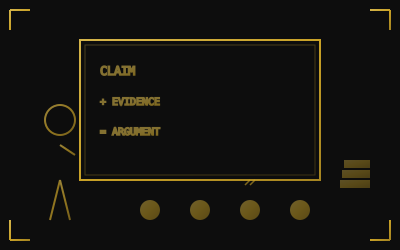
Week One: The Claim-Evidence-Reasoning Framework. Before students can debate, they need the basic unit of argument. Teach them that every argument has three parts: a claim (what you believe), evidence (why you believe it), and reasoning (why the evidence supports the claim). Have students practice identifying these components in simple statements, then construct their own. For elementary students, start with "I think chocolate ice cream is best because it has the most flavor, which matters because taste is what makes dessert enjoyable." Middle schoolers can tackle "Schools should start later because sleep research shows teenagers need 8-10 hours, and current schedules make that impossible." High schoolers should work with policy claims requiring research.
Week Two: Listening and Response. Debate isn't monologue—it's exchange. Introduce the concept of direct response: you must address what your opponent actually said, not just repeat your own points. The exercise that builds this skill is "Yes, and..." or "Yes, but..." Students can only speak after acknowledging their opponent's point. "Yes, you're right that chocolate ice cream is popular—but popularity doesn't equal quality. The best flavor is actually..." This forces genuine engagement rather than parallel talking.
Week Three: Four Corners. Introduce physical movement to make argument visible. Post "Strongly Agree," "Agree," "Disagree," "Strongly Disagree" signs in the room's corners. Read a statement and have students move to their corner, then defend their position. After hearing arguments, allow students to change corners if persuaded. This makes persuasion concrete—you can see when minds change. Good starter statements: "Homework should be optional." "Everyone should learn to code." "Athletes deserve high salaries." Adjust complexity for age.
Week Four: Mini-Debates. Pair students for short structured debates: 2 minutes each side, 1-minute rebuttal each. Keep topics low-stakes and accessible: "Should phones be allowed in school?" "Is it better to be smart or kind?" "Should voting be mandatory?" The time constraint forces focus. Students learn that they can't say everything—they must choose what matters most.
Week Five: Team Debates. Now combine pairs into teams of 3-4. Introduce role division: one person gives the opening, one handles rebuttal, one summarizes. This teaches collaboration and specialization. Topics can grow more substantial: "Should college be free?" "Is social media harmful to democracy?" "Should the voting age be lowered to 16?"
Week Six: The Tournament. Culminate with a mini-tournament. Each team debates twice on opposite sides of the same motion—this is crucial for developing intellectual flexibility. Simple judging criteria: clarity of argument, responsiveness to opponents, quality of evidence. Celebrate good arguments on both sides, not just winners.
Sample motions by age: Elementary: "Pets should be allowed in school." "Summer vacation should be shorter with more breaks." "Kids should choose their own bedtimes." Middle school: "Social media should require age verification." "Standardized testing does more harm than good." "Students should grade their teachers." High school: "The United States should adopt universal basic income." "Civil disobedience is justified when laws are unjust." "Privacy is more important than security."
Common mistakes new coaches make: First, picking topics too complex for the time available. A good debate topic can be understood in thirty seconds but argued about for hours. Second, not enforcing time limits—debates that drag on lose energy. Third, letting students prepare only one side. Arguing both sides isn't wishy-washy; it's essential for genuine understanding. Fourth, focusing on winning rather than learning. The goal is better thinking, not trophies. Fifth, skipping the debrief. After every debate, ask: What arguments worked? What did you learn from your opponent? What would you do differently? The debrief is where learning consolidates.
After any classroom debate, ask these questions (in this order):
- To the class: "What was the strongest argument you heard from the side you disagreed with?" This forces students to listen to opponents, not just wait for their turn.
- To each speaker: "What's one thing you'd change about your argument if you could do it again?" This builds reflective practice.
- To everyone: "Did anyone's thinking change during the debate? How?" Normalizes mind-changing as a sign of strength, not weakness.
Never announce a winner in classroom debates. The goal is thinking, not victory. Students who "lost" may have learned more.
WHAT A SUCCESSFUL SESSION LOOKS LIKE
Theory is helpful. But what actually happens when it works? Here's a composite of successful classroom debate sessions:
2:15 PM, seventh-grade English class. The topic: "Should schools assign summer reading?" Students have had ten minutes to prepare in groups of three. The teacher calls time.
2:17 PM. First speaker for the affirmative: "Summer reading keeps students from losing skills over the break. Studies show kids can lose months of progress without practice. And it introduces them to books they'd never pick themselves." Her voice shakes slightly—she's not a natural public speaker—but she makes it through.
2:19 PM. First speaker for the negative: "Summer is supposed to be a break. Kids are burned out by June—they need time to rest, not more assignments. And forced reading makes kids hate reading. My sister had to read a book she hated and now she won't read anything." He's confident, maybe too confident, getting a laugh from friends.
2:21 PM. The rebuttal round begins. This is where success shows. The affirmative speaker doesn't just repeat her points—she responds: "He said kids need rest, but reading a book over three months isn't exhausting. And if his sister hated her assigned book, maybe the problem was the book choice, not assigned reading itself." She's engaging, not just performing.
2:25 PM. The closing statements. Both sides summarize. Both are clearer than when they started—the act of being challenged sharpened their thinking.
2:27 PM. The debrief—the most important part. The teacher doesn't announce a winner. Instead: "What was the strongest argument you heard from the other side?" Pause. Then hands go up. The students who opposed summer reading acknowledge the skill-loss research was hard to counter. The pro-summer-reading team admits they didn't have a good answer for student burnout. The shy speaker who was nervous gets praised for her direct response. The confident speaker learns that getting laughs isn't the same as winning arguments.
What made this session work? Time limits forced focus. The topic was accessible—every student had an opinion. The debrief emphasized learning over winning. And crucially: nobody was humiliated. The nervous speaker found she could do it. The confident speaker found he had room to grow. Both learned something they didn't know before.
HANDLING THE HARD PARTS
Debate in classrooms creates tensions that teachers must navigate. Not every session goes smoothly, and pretending otherwise doesn't help.
The anxiety problem. Public speaking terrifies many students. Forcing them into debate before they're ready can backfire, reinforcing fear rather than building confidence. The solution isn't to exempt anxious students—that teaches avoidance. It's to scaffold: start with low-stakes pair discussions, then small group debates, then full-class presentations. Let nervous students begin with support roles (timekeeper, note-taker) before speaking. Build the muscle gradually.
The power dynamics problem. Classrooms aren't neutral spaces. The popular kid's argument carries social weight the quiet kid's doesn't. Boys often dominate discussion time. Students from marginalized groups may hold back, having learned that their voices aren't valued. Teachers must actively manage this: ensure equal speaking time, sometimes assign roles to counteract social dynamics, explicitly praise substance over style. Debate can either reinforce classroom hierarchies or disrupt them—which happens depends on how it's facilitated.
The topic sensitivity problem. Some debate topics hit too close to home. Debating immigration policy when immigrant children are in the room, debating family structures when students come from varied homes—these can wound rather than teach. The answer isn't avoiding all sensitive topics, which would eliminate the most important questions. It's being thoughtful about timing, framing topics abstractly when needed, and creating space for students to opt out without shame when a topic is too personal.
When it fails. Sometimes a debate session falls flat. Students aren't engaged. Arguments stay shallow. The debrief yields shrugs instead of insights. When this happens, diagnose: Was the topic too abstract? Were students underprepared? Was there not enough time? Was one side obviously stronger, killing genuine engagement? Every failed session teaches you something about the next one.
THE GOAL OF EDUCATION
At root, the debate about debate is a debate about what education is for. If the purpose of school is to transmit information—to fill students with facts they can recite on demand—then lecture and testing make sense. Debate would be a distraction from the real work of coverage.
But if the purpose of school is to develop minds—to create people who can think clearly, argue persuasively, and navigate a complex world—then debate belongs at the center, not the margins. The medieval masters understood this. They knew that knowledge which couldn't withstand challenge wasn't knowledge worth having. They built institutions around the conviction that truth emerges through argument.
We've inherited their universities without inheriting their methods. We've kept the buildings and the degrees while abandoning the disputations that gave them meaning. The result is an educational system that sorts and certifies but doesn't always educate—that produces credentials without always producing the thinking that credentials are supposed to represent.
Bringing debate back into schools won't solve every educational problem. But it would address a critical gap: the development of young people who can think for themselves, argue for their positions, and engage productively with those who disagree. In a world drowning in information and starving for wisdom, that might be the most valuable thing education could provide.
The student who never argues for positions they reject never learns how ideas actually work.
EXERCISES
Your Argumentative Education
Think back on your own schooling. When were you taught to argue? What opportunities did you have—or lack—to practice constructing and defending positions? How did this shape your current ability to engage in productive disagreement? What do you wish you'd learned?
Design a Classroom Debate
Pick a topic from a subject you know (history, science, literature, current events). Design a 20-minute debate suitable for a classroom: what's the resolution? How would you divide the class? What rules would you set? What would you want students to learn?
Teach Someone to Argue
Find a young person—a child, a student, a mentee—and spend 30 minutes teaching them one argumentation skill. It might be how to structure a claim with evidence, how to respond to an objection, or how to listen actively. Observe what they find difficult and what clicks. What did you learn from teaching?