What separates a compelling argument from a pile of good points?
You can have all the evidence in the world, all the logic, all the passion—and still fail to persuade. You present your facts. Your audience nods along. And then nothing happens. They don't change their minds. They don't take action. Your mountain of evidence collapses into forgettable noise. Something is missing. That something is structure.
A case is more than a collection of points. It's an architecture. The individual arguments are bricks; the case is the building. Pile bricks randomly and you get rubble. Arrange them with intention and you get a structure that can weather attack. "If it doesn't fit, you must acquit"—Johnnie Cochran's famous line worked because it compressed complex forensic debates into a memorable principle. Structure gave his argument staying power. This chapter is about that architecture: how to organize arguments into coherent cases that audiences can follow, remember, and accept.
The point of clash—the central issue on which a dispute turns. Stasis theory, developed by Hermagoras in the second century BCE, identifies four possible points of disagreement: fact (did it happen?), definition (what should we call it?), quality (was it justified?), and procedure (are we handling this correctly?).
FINDING YOUR STASIS
Before you can build a case, you need to know what you're arguing about. This sounds obvious but isn't. Many debates fail because the participants argue past each other, addressing different questions while thinking they're in the same conversation.
The Greeks developed stasis theory to identify exactly where disagreements lie. Four basic questions: Did the thing happen (fact)? What should we call it (definition)? Was it right or wrong (quality)? Are we addressing it properly (procedure)? Every dispute ultimately rests on one of these questions. Finding the stasis clarifies what you need to prove and what's beside the point.
Consider a workplace conflict. An employee is accused of harassment. The stasis might be fact: Did the alleged behavior actually occur? Or it might be definition: Everyone agrees something happened, but was it harassment or just awkward socializing? Or it might be quality: The behavior meets the definition of harassment, but were there mitigating circumstances? Or it might be procedure: Everyone agrees something wrong happened, but is termination the appropriate response?
Each stasis requires a different case. If the dispute is factual, you need evidence about what happened. If it's definitional, you need to establish criteria for the category. If it's about quality, you need to argue about justification or extenuating factors. If it's procedural, you need to argue about appropriate remedies. Building a great case about the wrong stasis is worse than useless—it makes you look like you're evading the real question.
THE TOULMIN MODEL
Stephen Toulmin was a British philosopher who became frustrated with formal logic. Syllogisms worked fine in mathematics, he thought, but they failed to capture how people actually argued in law, ethics, and everyday life. In 1958 he proposed an alternative: a model of practical argument with six components.
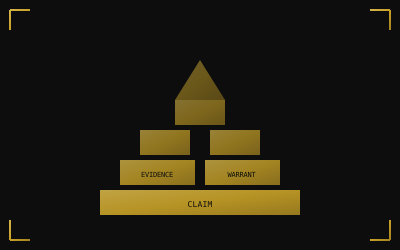
The claim is what you're asserting—your conclusion, the point you want the audience to accept. The grounds (or data) are the evidence supporting that claim—the facts, examples, and information you're offering. The warrant is the logical connection between grounds and claim—the principle that explains why your evidence supports your conclusion.
The logical bridge between evidence and conclusion. Warrants answer the question "Why does this evidence support this claim?" They're often unstated, like the premises in enthymemes, but identifying them is crucial for understanding and attacking arguments.
Three additional components handle complexity. The backing supports the warrant itself—if someone challenges your logical bridge, backing provides foundation for it. The qualifier indicates the strength of your claim (probably, certainly, usually). The rebuttal acknowledges conditions under which the claim might not hold.
Arguments are like organisms. They have a structure and a natural history. They grow, change, and sometimes die.Stephen Toulmin — The Uses of Argument, 1958
Here's a simple example. Claim: "John is probably a British citizen." Grounds: "John was born in Bermuda." Warrant: "People born in British colonies are generally British citizens." Backing: "British Nationality Act establishes this principle." Qualifier: "Probably" (not certainly). Rebuttal: "Unless John has renounced citizenship or Bermuda has changed status."
The model's power lies in making warrants explicit. Remember the enthymeme from Chapter 9—arguments with unstated premises. The warrant is that unstated premise. Making it visible lets you see where arguments succeed and fail. A strong warrant connects evidence to conclusion convincingly. A weak warrant creates a gap the audience won't cross.
ORGANIZING YOUR ARGUMENTS
You have your stasis. You have your claims with grounds, warrants, and backing. Now you need to arrange them into a case. The order matters more than most speakers realize.
Classical rhetoric recommended a specific structure: exordium (introduction), narratio (background and statement of facts), divisio (outline of arguments), confirmatio (arguments for your position), refutatio (responses to counterarguments), and peroratio (conclusion). This structure served Roman orators for centuries and still works today. It moves from establishing context to building your case to addressing the opposition to driving home your conclusion.
Strip away the Latin, and you'll recognize this structure in every boardroom presentation, investor pitch, and quarterly review. The executive opens with a hook (exordium), presents market context (narratio), outlines three key points (divisio), argues for the proposal with data (confirmatio), addresses objections the CFO will raise (refutatio), and closes with a call to action (peroratio). The format survives because it maps how minds process persuasion: orient me, ground me, tell me where we're going, make your case, earn my trust by anticipating my doubts, then move me to act.
But within that structure, how do you order individual arguments? Three main approaches.
Strongest first works when you need to capture attention and establish credibility quickly. Lead with your most compelling point, and audiences will listen to what follows. The risk: if your second and third arguments are weaker, the case can feel like it's declining.
Strongest last works when you can hold attention throughout and want to build toward a climax. Audiences remember endings. If your final argument is your strongest, it's what they carry away. The risk: if early arguments are weak, the audience may tune out before you reach the peak.
Strong-weak-strong (the Nestorian order, named after an ancient memory technique) buries weaker arguments in the middle where they're less noticeable. Open strong to capture attention, let middle arguments do necessary but less exciting work, close strong to leave a lasting impression. This is often the best default for complex cases.
THE ONE-SENTENCE TEST
Before you deliver a case, you should be able to state its central claim in a single sentence. Not a paragraph. Not a speech. One sentence. If you can't do this, your case isn't clear enough yet.
The one-sentence test forces precision. What exactly are you arguing? Strip away the elaboration, the evidence, the supporting points. What's the core claim you want the audience to accept? "The defendant is not guilty." "We should adopt this policy." "This interpretation of the evidence is correct." Simple, clear, memorable.
If you can't explain it simply, you don't understand it well enough.Attributed to Albert Einstein
This core sentence becomes your thesis—the organizing principle for everything else. Every argument you include should connect to it. Evidence that doesn't support the thesis doesn't belong, no matter how interesting it is. Tangents that don't advance the thesis should be cut. The discipline of the one-sentence test keeps your case focused.
The test also helps your audience. If they can remember one thing about your argument, what should it be? Give them the thesis clearly and early. Repeat it at key moments. Return to it in your conclusion. A case the audience can summarize in one sentence is a case they can remember, discuss, and ultimately accept.
ANTICIPATING OBJECTIONS
Experienced advocates build their cases with the opposition in mind. What will they attack? Where are the weak points? What counterarguments will they raise? Addressing these questions during construction produces stronger cases than waiting for attacks and scrambling to respond.
This is the strategic value of the Toulmin model. Look at your warrants. Are they solid? Will the audience accept them? If a warrant is weak, you need backing—support for the logical connection itself. If you can't provide backing, the argument may not be worth including.
Consider the obvious objections. Any argument worth making has counterarguments. Pretending they don't exist makes you look naive or dishonest. Acknowledging them shows sophistication and builds credibility. You don't have to refute every possible objection, but the major ones should be addressed.
The beginning of wisdom is the definition of terms.Socrates — As reported by Plato
Consider definitional disputes. Many arguments hinge on how key terms are defined. Your opponent may accept your facts and reasoning but reject your definition. Anticipate this. Define terms clearly and defend those definitions. Chapter 12 will explore how opponents attack arguments; knowing those techniques helps you build cases that resist them.
THE COMPLETE CASE
A complete case has several components working together. An opening that captures attention and establishes what's at stake. A thesis that states your central claim clearly. Arguments organized to build momentum and stay memorable. Evidence appropriate to your audience. Warrants that connect evidence to claims. Acknowledgment of counterarguments and responses to them. A conclusion that drives home your thesis and calls for the response you want.
Cicero's model remains useful. His speeches began by winning the audience's goodwill (establishing ethos), then laid out the facts of the situation (providing context), then presented arguments (building the case), then addressed counterarguments (refuting the opposition), then concluded with a powerful appeal (securing the verdict). Each section had a specific function. Nothing was wasted.
Modern debate formats compress this structure but maintain its logic. A policy debate case presents a problem (significance), shows the current system can't solve it (inherency), offers a solution (plan), demonstrates the solution works (solvency), and shows benefits outweigh costs (advantages). Different format, same principle: take the audience from where they are to where you want them to be, step by logical step.
The art lies in adapting structure to situation. A courtroom summation differs from a board presentation differs from a dinner-table argument. The principles are the same—clear thesis, organized arguments, solid warrants, anticipated objections—but the application varies. The skilled advocate reads the situation and adjusts the architecture accordingly.
TEMPLATES FROM THE PROVING GROUND
"Place" or "places"—common patterns of argument that can be applied across many topics. Aristotle catalogued these "topics" as starting points for building cases: comparison, cause and effect, definition, degree ("if X is true, then certainly Y"), example. Topoi are mental templates: when you need an argument, you cycle through the common patterns until one fits. Skilled arguers internalize so many topoi that generating arguments becomes automatic.
Competitive debate has evolved distinct formats, each encoding lessons about what makes cases hold together under attack. These aren't just tournament conventions—they're templates refined by decades of high-pressure testing. Every weakness that can be exploited has been. What survives works. You can adapt these structures for any situation where you need to make a persuasive case quickly.
The policy template addresses proposals for change. It requires you to establish why the problem matters (significance), why current approaches can't solve it (inherency), what specifically should change (plan), why the change will work (solvency), and why benefits outweigh costs (advantages). This structure maps directly to the Toulmin model: each stock issue is a warrant that must hold. Miss one, and the case collapses. When proposing anything—a new project, a budget reallocation, a strategic shift—run through these five questions. If you can't answer them all, your case isn't ready.
The values template handles philosophical disputes. It requires you to establish a framework (what value matters most in this context), show how your position advances that value, and demonstrate why your opponent's position undermines it. This structure forces you to fight on the ground of principle rather than just consequences. When disagreements feel intractable, often it's because the parties haven't made their underlying values explicit. The values template surfaces that hidden layer.
The accessibility template prioritizes reaching non-expert audiences. It constrains you to clear resolution statements, arguments that work without jargon, and evidence that ordinary listeners can evaluate. This structure is closest to what you'll need in most real-world persuasion: board presentations, difficult conversations, public forums where your audience hasn't spent years studying the topic.
Which template when? Use the policy template when proposing concrete change: a new initiative, a budget request, a strategic pivot. Your audience needs to see the problem, the fix, and the path forward. Use the values template when the dispute is fundamentally philosophical—when you and your opponent might agree on facts but disagree on what matters. Framing a debate around values works when you can win on principles, even if individual data points are contested. Use the accessibility template when your audience isn't expert—juries, community meetings, most workplace settings. The argument that's technically stronger but incomprehensible to your audience loses to the weaker argument they actually understand.
Different situations demand different case lengths. Here are templates for three common timeframes:
30 seconds (elevator pitch): One sentence of context. One sentence of claim. One sentence of single strongest reason. Example: "We're losing engineers to competitors. We should match industry salaries. Our exit interviews show compensation is the top reason people leave."
2 minutes (meeting intervention): Context (15 sec) → Thesis (10 sec) → Three reasons with brief evidence (30 sec each) → Call to action (15 sec).
5 minutes (formal presentation): Hook (30 sec) → Problem and stakes (45 sec) → Thesis (15 sec) → Three arguments with evidence (60 sec each) → Anticipated objection and response (45 sec) → Conclusion and call to action (30 sec).
These templates are scaffolding, not scripture. Complex topics resist compression, and some audiences need more context. Adapt the structure to your situation—the template tells you what elements matter, not that every case must follow it mechanically.
SuperDebate's 5-minute constructive demands efficient case architecture. Here's a structure that works:
- Hook (0:00-0:30): One sentence that captures the core tension. Don't waste time on preamble.
- Framework (0:30-1:00): What lens should judges use to evaluate this round? Define your value or standard briefly.
- Contention 1 (1:00-2:30): Your strongest argument. Claim → Warrant → Evidence → Impact. Ninety seconds, no more.
- Contention 2 (2:30-4:00): Your supporting argument. Same structure. If time allows, a brief third contention.
- Signpost to Close (4:00-5:00): Recap what you've proven. "My opponent must answer X and Y to win this round."
Practice this structure until it's automatic. When topics are announced, you're not building from scratch—you're filling in a template you've internalized. See the SuperDebate Format Guide and Debate Preparation Playbook for complete preparation strategies.
The podcast interview format Intelligence Squared offers another model: Oxford-style debate where audiences vote before and after, with victory going to whichever side moves more voters. This structure prizes accessibility over technical skill. The debaters who win aren't necessarily the most erudite—they're the ones who make undecided listeners say, "I hadn't thought of it that way." Watching these debates teaches what moves real minds as opposed to what impresses judges trained in technical formats.
Building a case is construction work. It requires planning, materials, and technique. But unlike buildings, cases must withstand active attack. The next chapter explores how opponents try to tear cases down—knowledge that helps you build cases that stand.
If you can't state your argument in one sentence, you don't understand it yet. Clarity precedes persuasion.
EXERCISES
Your Stasis Sensitivity
Think of a recent disagreement you had. What was the actual stasis—the point where you and the other person truly disagreed? Was it fact, definition, quality, or procedure? Did the conversation address the real stasis or drift into other territory? Understanding where disagreements actually lie improves your ability to resolve them.
Toulmin Mapping
Take an argument from an editorial or opinion piece and map it using Toulmin's model. Identify the claim, grounds, and warrant. Look for qualifiers and rebuttals. Is there backing for the warrant? Most importantly: is the warrant strong enough to connect the grounds to the claim? This analysis reveals strengths and weaknesses invisible to casual reading.
The Complete Case
Choose a position you hold on a controversial issue. Build a complete case using classical structure: introduction, statement of facts, arguments, responses to counterarguments, conclusion. Your case should pass the one-sentence test and address the correct stasis. Practice delivering it in five minutes. Then have someone argue against it and see what holds up.