Why do people believe obvious lies? Not subtle deceptions dressed in plausible clothing, but bold, verifiable falsehoods that anyone could check in thirty seconds? This question haunts modern discourse, but the Greeks had an answer. They understood something we've forgotten: belief doesn't flow primarily from evidence. It flows from trust.
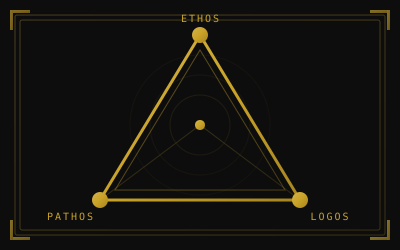
If you trust the speaker, you'll believe improbable claims. If you distrust them, you'll reject claims with overwhelming evidence. This isn't stupidity. It's efficiency. We can't verify everything ourselves. We have to rely on others. So we develop shortcuts for deciding whom to believe. And those shortcuts aren't about logic. They're about character, emotion, and relationship. The Greeks called this complex of factors the three appeals: ethos, pathos, and logos. Together, they form the rhetorical triangle, the framework that explains how persuasion actually works.
The appeal to character and credibility. Ethos is why you trust a mechanic's diagnosis of your car trouble but not your neighbor's guess. It's not just credentials; it's the sense that the speaker is trustworthy, knowledgeable, and has your interests at heart.
ARISTOTLE'S FRAMEWORK
Book I of Aristotle's Rhetoric opens with a simple observation: there are three means of persuasion available to a speaker. The first depends on the personal character of the speaker. The second on putting the audience into a certain frame of mind. The third on the proof, or apparent proof, provided by the words of the speech itself. That's it. Two and a half millennia of rhetorical theory rest on this foundation.
Of the modes of persuasion furnished by the spoken word there are three kinds. The first kind depends on the personal character of the speaker; the second on putting the audience into a certain frame of mind; the third on the proof, or apparent proof, provided by the words of the speech itself.Aristotle — Rhetoric, Book I, Chapter 2
Aristotle didn't invent these categories from pure theory. He observed what worked. Skilled speakers had always used character, emotion, and logic to persuade. Aristotle's contribution was to make the pattern explicit, to analyze how each appeal functioned, and to show how they worked together.
The metaphor of a triangle is useful here, though it's not Aristotle's own. Each appeal forms one side. A speech that neglects any side is structurally weak. Heavy on logic but lacking in character appeal? Cold and unconvincing. Rich in emotion but thin on evidence? Manipulative. Full of personal credibility but offering no reasons? Authoritarian. The strongest arguments balance all three.
But balance doesn't mean equal portions. Different situations call for different emphasis. A scientific paper relies heavily on logos, with ethos established by credentials and methodology. A eulogy is mostly pathos, with logos reduced to biographical facts. A character witness at trial is almost pure ethos. The skilled speaker reads the situation and adjusts accordingly.
Watch how this plays out in a modern product launch. Apple's keynotes are masterclasses in the rhetorical triangle. Ethos comes first: the presenter is introduced with credentials, the company's track record of innovation is invoked, the stage design itself signals competence and taste. Then pathos: a story about a customer whose life was changed, footage of people delighted by the product, music that stirs anticipation. Finally logos: the specifications, the benchmarks, the side-by-side comparisons. Each appeal prepares the ground for the next. By the time the price appears on screen, the audience has been led there through a carefully constructed sequence of trust, feeling, and reason.
Political advertising follows the same pattern, often more crudely. The candidate appears in a flag-draped setting (ethos through visual association), speaks about threats to "our way of life" (pathos through fear), then references a policy position almost as an afterthought (token logos). The most effective ads balance all three; the manipulative ones abandon logos entirely and hammer ethos and pathos until the audience stops thinking. Understanding the triangle lets you see these techniques at work—and resist them when they're being used to bypass your judgment rather than inform it.
ETHOS: WHY TRUST MATTERS MORE THAN TRUTH
This will sound cynical, but it's not meant to be: in most situations, who you are matters more than what you say. Audiences don't have time to evaluate every argument on its merits. They use shortcuts. And the most powerful shortcut is asking: Do I trust this person?
Aristotle broke ethos into three components. Phronesis, or practical wisdom: Does this person know what they're talking about? Arete, or virtue: Does this person have good character? Eunoia, or goodwill: Does this person have my interests at heart? A speaker who establishes all three becomes nearly impossible to argue against. A speaker who lacks any one faces an uphill battle no matter how strong their evidence.
The appeal to emotion. Not manipulation, but the recognition that humans are feeling creatures who make decisions based on emotions as well as reason. Effective pathos makes the audience feel what's appropriate to the situation.
Consider the doctor analogy again. When your physician says you need surgery, you probably don't demand to see the peer-reviewed studies. You trust her expertise (phronesis), her commitment to medical ethics (arete), and her concern for your health (eunoia). If you didn't trust her, no amount of evidence would convince you to let her cut you open.
This explains why credible speakers can get away with weak arguments and incredible speakers fail with strong ones. It also explains why building ethos should often come before making arguments. Chapter 5 will explore how to build credibility systematically. For now, just notice that the triangle isn't an equilateral one. Ethos often carries the most weight.
PATHOS: THE ETHICAL ROLE OF EMOTION
Emotion in argument has a bad reputation. We're supposed to be rational. We're supposed to evaluate claims on their merits. Appeals to emotion are often called fallacies. But Aristotle disagreed. He devoted an entire book of the Rhetoric to analyzing emotions, and he treated them as legitimate tools of persuasion.
Why? Because emotions carry information. Fear tells you something is dangerous. Anger tells you an injustice has occurred. Pity tells you someone is suffering undeservedly. These aren't random noise interfering with clear thinking. They're judgments about the world, albeit rapid and intuitive ones. A speaker who ignores emotion isn't being more rational. They're being less persuasive, and often less honest about the stakes.
The emotions are all those feelings that so change men as to affect their judgments, and that are also attended by pain or pleasure.Aristotle — Rhetoric, Book II, Chapter 1
The key phrase is "affect their judgments." Aristotle understood that emotions don't just accompany our decisions; they shape them. A juror who feels pity for the defendant will judge the case differently than one who feels outrage at the crime. Neither response is wrong. The question is which emotion fits the facts. If the defendant truly deserves pity, then evoking pity serves justice. If the crime truly deserves outrage, then evoking outrage does the same.
The ethical use of pathos means evoking emotions appropriate to the situation. The unethical use means evoking emotions that distort judgment: making people fear what isn't dangerous, pity what isn't pitiable, hate what doesn't deserve hatred. Chapter 7 will explore this distinction in depth. For now, the point is that pathos isn't inherently manipulative. It becomes manipulative only when divorced from truth.
LOGOS: LOGIC AS ARCHITECTURE
The appeal to logos is the appeal to reason. Evidence, arguments, syllogisms, examples. This is what most people think of when they think of persuasion: marshaling facts to prove a point. But Aristotle's treatment of logos is subtler than just "use logic."
The appeal to reason and evidence. Logos encompasses the logical structure of an argument, the quality of evidence offered, and the clarity with which conclusions follow from premises. The word also means "word" and "reason" in Greek—language and logic intertwined.
The Rhetoric distinguishes between two kinds of logical proof: induction and deduction. Inductive arguments move from examples to generalizations. "This swan is white, and that swan is white, and the other swan is white; therefore all swans are white." Deductive arguments move from general principles to specific conclusions. "All swans are birds. All birds lay eggs. Therefore, all swans lay eggs."
In formal logic, deduction is airtight. If the premises are true and the form is valid, the conclusion must follow. But rhetoric rarely achieves such certainty. Rhetorical deduction uses what Aristotle called the enthymeme: a syllogism with one premise unstated, relying on the audience to supply it. "She's a mother, so she understands what it's like to worry about children." The unstated premise: "All mothers worry about their children." The argument only works if the audience accepts that premise.
The enthymeme must consist of few propositions, fewer often than those which make up the normal syllogism. For if any of these propositions is a familiar fact, there is no need even to mention it; the hearer adds it himself.Aristotle — Rhetoric, Book I, Chapter 2
This is why logos functions as architecture rather than just content. The logical structure of your argument determines which unstated premises you're asking your audience to accept. A skilled speaker chooses structures that rely on premises the audience already holds. A clumsy speaker builds arguments that depend on premises the audience rejects.
Chapter 9 will explore argument construction in detail. But the foundation is this: logic in rhetoric isn't about proving things with mathematical certainty. It's about building arguments that fit what your audience already believes while extending those beliefs in the direction you want them to go.
THE TRIANGLE IN BALANCE
Cicero, the greatest Roman orator, inherited Aristotle's framework and put it into practice at the highest levels of public life. His speeches to the Roman Senate demonstrate what balanced use of the three appeals looks like.
Consider his First Catilinarian Oration. Cicero was accusing a senator named Catiline of plotting to overthrow the Republic. The stakes were enormous, and Cicero had to persuade the Senate to act against one of their own members.
He opens with ethos. He reminds the Senate of his position as consul, of his past services to the state, of his personal integrity. He establishes that he's not acting from personal animosity but from duty. Then he moves to pathos. He evokes the fear that the conspiracy should inspire, the outrage at Catiline's audacity, the shame that should fall on anyone who protects him. Only then does he present the logos: the evidence of the conspiracy, the logical chain connecting Catiline to the plotters, the necessary conclusion that action must be taken.
How long, O Catiline, will you abuse our patience? How long will that madness of yours mock us? To what end will your unbridled audacity hurl itself?Cicero — First Catilinarian Oration, 63 BCE
Notice the structure. Cicero doesn't start with evidence. He starts with character and emotion, priming the audience to receive his argument favorably. The evidence comes once the audience is already disposed to believe it. This isn't manipulation; it's recognition that humans process persuasion through character and emotion first, logic second.
The balance also means adjusting emphasis for context. A philosophical treatise can lean heavily on logos because readers have time to evaluate arguments carefully. A courtroom summation needs more pathos because jurors make decisions they can't take back. A recommendation letter is almost pure ethos because the writer's credibility is the whole point. The triangle isn't a formula. It's a framework for thinking about what any particular situation requires.
WHEN THE TRIANGLE BREAKS
Understanding the triangle also helps you see what's wrong with bad arguments. When you encounter persuasion that feels manipulative or hollow, you can usually trace the problem to an imbalance in the appeals.
Propaganda typically overweights ethos and pathos while starving logos. The charismatic leader, the emotionally charged imagery, but no actual argument. Academic writing often has the opposite problem: plenty of logos, but the author's character vanishes behind passive voice and jargon, and emotional stakes go unacknowledged. Both fail to persuade because both abandon balance.
Social media breaks the triangle in a different way. Character is impossible to establish in 280 characters. Logical argument requires more space than the medium allows. What's left is pure pathos: emotional reaction without the tempering influence of credibility or reason. No wonder our discourse is in trouble. We've built communication tools that systematically disable two-thirds of the rhetorical framework.
This framework gives you a diagnostic tool. When an argument isn't working, ask: Which appeal is weak? When you're constructing an argument, ask: Have I addressed all three? The triangle doesn't guarantee success, but ignoring it guarantees certain kinds of failure.
PUTTING THE TRIANGLE TO WORK
Here's how to use the rhetorical triangle in your next important argument:
Before any important persuasion—email, meeting, presentation—answer these three questions:
- Ethos: Why should they trust me on this? (One sentence on your relevant credibility)
- Pathos: Why should they care? (What's at stake for them, emotionally or practically)
- Logos: What's my because? (The core reason stated simply)
If you can't answer all three, your argument isn't ready.
In competitive debate, you have five minutes to build your case. Here's how to balance all three appeals under time pressure:
- First 30 seconds (Ethos): Hook the judges. Show you understand the topic's complexity. Signal confidence without arrogance.
- Minutes 1-4 (Logos): This is your case architecture. Two or three contentions with evidence, clear warrants connecting claims to conclusions.
- Final 30 seconds (Pathos): Why does this matter? Connect your logical case to real stakes—people affected, values at risk, consequences of getting this wrong.
Novice debaters lean too heavily on logos and neglect the bookends. Your opening ethos makes judges want to believe you; your closing pathos makes them care about believing you. See the SuperDebate Format Guide for detailed phase-by-phase tactics.
During the argument, track which appeal is doing the most work. If you find yourself relying entirely on data, add a human story. If you're all emotion, introduce evidence. If you're leaning on your credentials, show your reasoning. Balance in real-time.
When analyzing others' arguments, identify which appeal they're using at each moment. Skilled persuaders shift fluidly between all three. Manipulators typically hammer one appeal while ignoring the others. Once you see the pattern, you're harder to fool.
THE TRIANGLE IN YOUR INBOX
The best TED speakers balance the triangle instinctively. Watch any of the most-viewed talks, and you'll see the pattern. Simon Sinek's "Start With Why" opens with logos—the framework of the golden circle—but lands emotionally with stories of Apple and Martin Luther King Jr. Brené Brown's vulnerability research could have been pure data (logos), but she weaves in personal narrative (ethos through authenticity) and speaks to universal fears of rejection (pathos). The talks that spread are rarely strongest in just one appeal.
Political advertising works the triangle too, though often more crudely. Attack ads overwhelm with pathos—fear, anger, disgust—while starving logos entirely. The candidate's own ads layer ethos (military service, family photos) over emotional appeals (hopeful music, sunset imagery) with minimal argument. Understanding this pattern doesn't make you immune to it, but it helps you recognize when you're being persuaded through imbalance.
Even your email inbox demonstrates the triangle. Effective requests establish credibility early ("As the person who built this system..."), connect to the reader's concerns ("I know the demo is tomorrow..."), and provide clear reasoning ("...so we need to push the update today because..."). Ineffective requests jump straight to demands without ethos, make claims without evidence, or lecture without acknowledging the reader's situation. The triangle applies everywhere persuasion happens.
BEGINNING THE DEEP DIVES
This chapter has introduced the framework. The next seven chapters will explore each element in depth. Chapters 5 and 6 examine ethos: how credibility is built, maintained, and demonstrated through argument itself. Chapters 7 and 8 explore pathos: the ethical use of emotion and Aristotle's detailed catalog of feelings. Chapters 9 and 10 take on logos: the construction of arguments and the evaluation of evidence.
But before we go deep, Chapter 4 introduces one more foundational concept: kairos, the art of timing. The triangle tells you what to say. Kairos tells you when.
The Greeks didn't give us these tools because they were abstract thinkers who enjoyed categorization. They gave us these tools because they needed them, urgently, for the work of citizenship in a democracy. We need them just as urgently now. The question is whether we'll use them as well.
Every act of persuasion balances ethos, pathos, and logos. Neglect any one, and the structure collapses.
EXERCISES
Mapping Your Own Persuasion
Think of the last time someone changed your mind about something that mattered. Which of the three appeals did they use most effectively? Was it their credibility, the emotions they evoked, or the logic of their argument? Most people find that one appeal dominated. What does this tell you about how you process persuasion?
Triangle Analysis
Find a persuasive piece of writing: an op-ed, a speech transcript, an advertisement. Read it carefully and identify every appeal to ethos, pathos, and logos. Mark them with different colors if that helps. Then assess the balance. Is the piece heavy on one appeal and light on others? How does this affect its persuasiveness?
Three Versions, One Topic
Choose a controversial topic. Write three short paragraphs arguing the same position, but each emphasizing a different appeal. The first paragraph should rely primarily on ethos, the second on pathos, the third on logos. Then write a fourth paragraph that combines all three.
Success criteria: Test each version by asking: Could I remove the appeal and still have an argument? Your ethos paragraph should collapse if you removed all credibility signals (expertise, experience, character). Your pathos paragraph should go flat if you removed emotional resonance. Your logos paragraph should have no force if you removed the logical structure. If any version still "works" without its core appeal, you've relied on a different appeal than intended—revise until each version depends on what it claims to depend on. The combined version succeeds if it's noticeably stronger than any single version alone.